
How water tanks ensure this precious resource is preserved and efficiently managed
Efficiently managing the vital water supply in horticulture production
A steady supply of fresh water is of crucial importance for any type of horticulture production. The water needs to be free of contaminants, with correct fertiliser and nutrient dosing and readily available during dry periods as well. All water that enters a horticulture production system is of high value; it is a precious resource and therefore reusing it is very important. Making sure it doesn’t get lost. How does this work? Irrigation specialists help you with irrigation precision, but we, as water storage specialists, would like to explain to you what important role water storage tanks play in a water system.
But first, what route does water – in simplified terms – follow in a horticulture production?
1. Water intake, disinfection, fertilisation
Water enters a production water system from a source. There can be multiple sources, such as groundwater, surface water, tap water, or rainwater. This is also the point where the water directly becomes part of the water cycle, as one of the water sources can also be recycled drain water. The water from these sources is disinfected, sometimes desalinated, neutralised, and the correct fertilisation recipes are added.
2. Irrigation
Colleagues have developed the most advanced greenhouse irrigation monitoring systems, making sure high-quality irrigation water and correct dosing reach the crops.
3. Discharge
After irrigation the water can be collected and treated again to ensure it can be (partially) recycled.
Although each production process is different and there are global variations and variations in technology and scale, water systems can operate in this way.
Water storage
These kinds of water systems in horticulture production can function as a (near) closed system, reusing large parts of the water. These water cycles can’t function without water storage systems. The most used storage systems are steel water tanks and excavated basins. The choice depends on the available space and the required quantity of water. Let us explain more about these storage systems.
Water basins
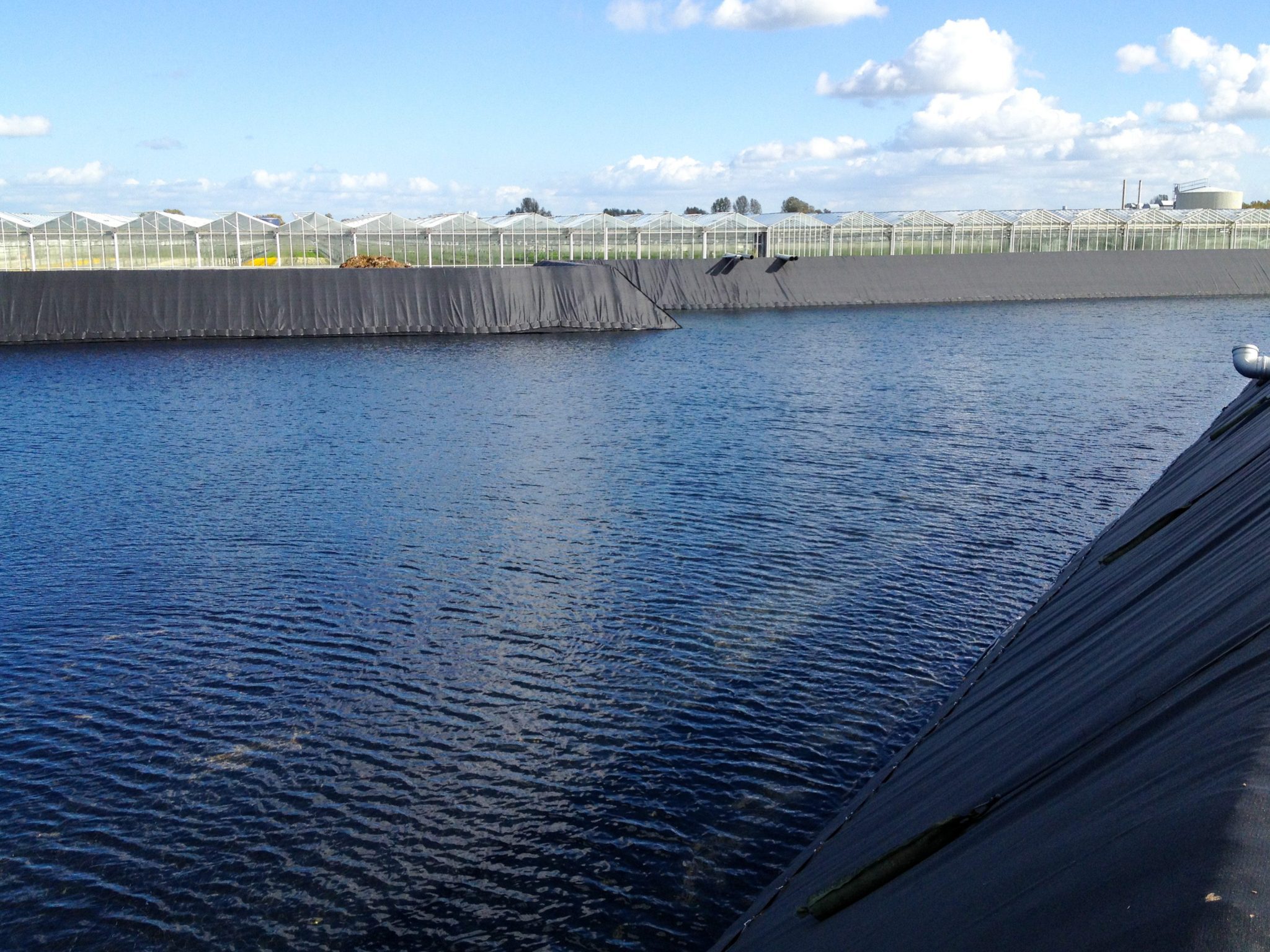
Water basins are globally installed frequently. These are excavated basins made up from earthen walls, lined with one of our high-quality films. Basins have multiple benefits, the most important being a large storage capacity, flexibility in shape and size and low investment cost per cubic metre.
In crop production, water basins serve perfectly to store (and collect) raw water, such as rain and surface water. Without covering the basin, maintaining the water quality can be a challenge, so filtration systems need to be in place before it can enter the water cycle.
Water storage tanks
Water is a delicate source in horticulture production because its quality and properties have a direct impact on crop growth and, consequently, on yields. Therefore, water must be handled very carefully, and for the storage of it, steel water tanks are the right storage systems at multiple points in a water system. How can they serve?
1. Water storage tanks can serve pre water treatment. Raw water from the different sources will be stored in tanks before it will be purified, neutralised and adjusted.
2. Fertilisers and nutrients will be added to the water and this mixed water is often stored in water storage tanks before it is lead to the plants.
3. Used water and evaporation water can be drained and stored before it (partially) is reused.
4. Discharge water can also be stored before it is discharged.

Water storage tanks can be used at different points in the water cycle to store water. In fact, any type of water involved in production can be stored in steel water tanks. But why using steel water tanks? What advantages does this specific type of water storage system offer?
Advantages of steel water tanks
- Water tanks offer a high control over water quality
- Large water capacities can be stored on a small area; space-saving
- We offer a wide range of tank sizes (heights and diameters) so they fit in every facility
- They are modular, so relocatable
- Steel water tanks are made from durable materials, including corrugated galvanised steel panels and high quality liners such as FPP. The materials are very durable and enable both indoor and outdoor installation.
- Simple installation
- Made to measure and finished to meet your needs. The steel thickness and the liner material can be adjusted and our silos can be finished in various ways with various optional extras. A water silo can be covered with a (floating) cover to preserve water quality and prevent algae growth or pollution from outside.
Without storage tanks, the closed system would not function efficiently or maintain water quality. Steel water tanks also ensure a continuous water supply, even when availability from precipitation fluctuates.
In short, the recycling of irrigation water offers significant opportunities to reduce water consumption, lower costs and alleviate pressure on local water resources. Click to read more about our water storage systems.


